
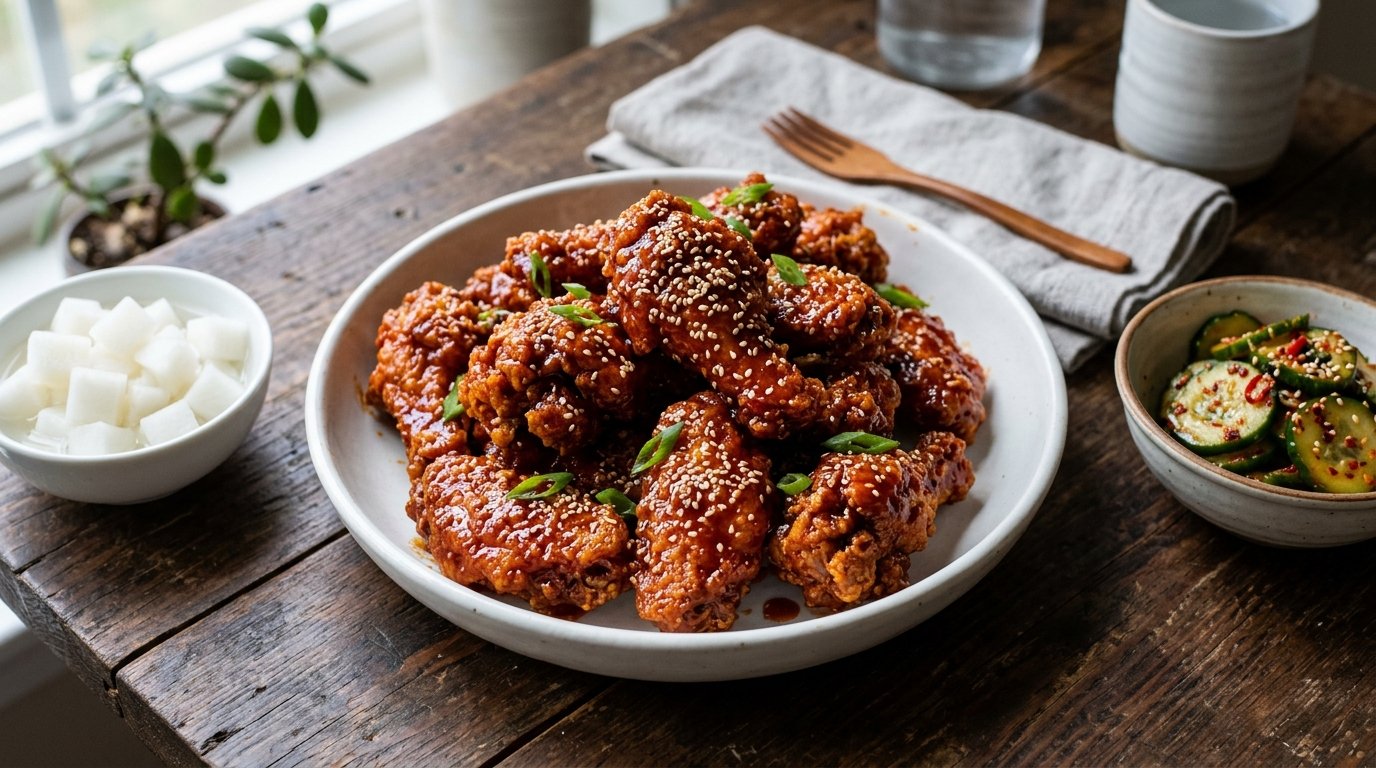
Yangnyeom chicken (양념치킨) means “seasoned chicken”: crisp fried chicken coated in a glossy, sweet, spicy and slightly sour red sauce built on gochujang. Outside Korea it’s the dish most people mean by “Korean fried chicken”. The coating is thin and shatters when you bite it, and the sauce clings in a sticky layer rather than a puddle.
It’s a fairly modern dish. Wikipedia credits the US military presence after the Korean War with introducing deep-fried chicken to Korea, and says the sauced version began in 1982 at a restaurant run by Yun Jonggye, who coated the chicken to soften its hard crust. Maangchi describes it as take-out food that Koreans rarely make at home, which is why a home version is worth having.
People order it for gatherings, game nights and casual dinners, usually shared from one big platter with plenty of napkins. The recipe below uses wings, double-fried, then tossed in the sauce at the last minute.
What you need
Potato starch. It makes up most of the coating and gives the thin, glassy crunch. One source notes that it also stops the skin from darkening too fast during the two fries. Most Asian grocers sell it, and cornstarch works if you can’t find it.
Gochujang. This fermented chilli paste gives the sauce its colour, mild sweetness and heat. Brands vary a lot in spiciness, so taste a little first. Gochujang normally contains wheat, so check the label if that matters to you.
Brown rice syrup (ssal-yeot). It makes the glaze sticky and shiny. Corn syrup is a common replacement, and Maangchi lists sugar as another option.
| Ingredient | Swap | What changes |
|---|---|---|
| Potato starch (80 g) | Cornstarch, same weight | Slightly harder, less delicate crust; still crisp |
| Brown rice syrup (80 ml) | Corn syrup, same volume; or about 60 g sugar simmered with 2 tbsp extra water | Corn syrup is almost identical; sugar gives a thinner glaze that needs a little longer to thicken |
| Gochujang (65 g) | 45 g gochugaru plus 1 tbsp extra ketchup, and an extra 1 tbsp syrup | Brighter, less fermented depth; a rough approximation, so taste and adjust |
| White vinegar (2 tsp) | Rice vinegar or apple cider vinegar, same amount | Slightly softer tang |
Korean fried chicken (yangnyeom chicken)
Double-fried chicken wings with a thin, crackly potato-starch crust, tossed in a sticky sweet, spicy and tangy gochujang glaze.
- Dairy-free
- Halal
Ingredients
Chicken and coating
- 1 kg chicken wings
- 1 tsp fine salt
- ½ tsp black pepper
- 1 egg
- 80 g potato starch, or cornstarch
- 40 g plain flour
- 1 tsp baking powder
- 1½ l neutral oil for deep-frying
Yangnyeom sauce
- 2 tsp neutral oil
- 3 cloves garlic
- 80 ml ketchup
- 80 ml brown rice syrup, or corn syrup
- 65 g gochujang, Korean chilli paste; contains wheat in most brands
- 1 tbsp soy sauce
- 2 tsp white vinegar, or apple cider vinegar
- 30 ml water
- 1 tbsp toasted sesame seeds
Equipment
Heavy deep pot or wok, Deep-fry thermometer, Instant-read thermometer, Wire rack, Wide frying pan, Slotted spoon or spider
Method
- Dry and season. Pat the wings very dry with paper towels, then toss with the salt and pepper in a large bowl. The surface should feel tacky, not wet.
- Coat. Whisk the potato starch, flour and baking powder together. Toss the wings with the beaten egg until lightly slicked, then add the dry mix and toss until every piece wears a thin, even coat with no wet patches. Shake off loose powder and rest the wings on a rack for 10 minutes until the coating looks matte.
- Heat the oil. Pour the oil into a heavy pot so it comes no more than halfway up the sides. Heat to 165°C, checking with a deep-fry thermometer.
- First fry. Lower in about a third of the wings, one at a time, without crowding. Fry for about 8 minutes, until the coating is set and pale golden and the thickest piece reads 74°C on a probe. Lift onto a rack, let the oil return to 165°C, and repeat with the remaining batches.
- Rest and make the sauce. Leave the wings to rest for at least 5 minutes. Meanwhile, heat the 2 tsp oil in a wide pan over medium-low heat and cook the garlic for 30 seconds until fragrant but not browned. Stir in the ketchup, rice syrup, gochujang, soy sauce, vinegar and water.
- Cook the sauce. Simmer over low heat, stirring, for about 7 minutes, until the sauce bubbles, turns shiny and coats the back of a spoon. Take it off the heat and keep it warm.
- Second fry. Raise the oil to 190°C. Fry the wings again in batches for 3 to 4 minutes, until deep golden and hard and crisp when tapped with tongs. Drain briefly on the rack, letting the oil return to 190°C between batches.
- Sauce and serve. Warm the sauce over low heat if it has thickened. Add all the wings and toss for about 30 seconds until evenly glossy. Tip onto a platter, sprinkle with sesame seeds and serve straight away.
Contains: eggs, gluten, sesame, soy. Check the labels on packaged ingredients.
Written with AI assistance and reviewed by a human editor. This recipe has not been cooked in a home kitchen, so taste and adjust as you go. The header picture is an AI-generated illustration, a stock photo or an official press picture, not a photo of this exact recipe. Use halal-certified meat.
Tips for success
- Dry the wings thoroughly. Surface water makes the oil spit and the coating slide off. Pat each piece with paper towels until it feels tacky, not wet.
- Keep the coating thin. Shake off loose starch before frying. A thick floury layer turns pasty under the sauce.
- Use a thermometer for the oil. The first fry is lower to cook the chicken and render fat from the skin; one source warns that too high a heat at this stage burns the outside before the inside is done. The second, hotter fry sets the crust.
- Fry in batches and let the oil recover. Crowding drops the temperature and gives greasy, soft chicken. Wait until the oil returns to the target before the next batch.
- Check doneness with a probe. USDA guidance for all poultry is 74°C in the thickest part, away from the bone. Colour alone can mislead, especially after the pale first fry.
- Sauce at the last minute. The glaze softens the crust by design, so toss only when you’re about to eat. Wings left sitting in sauce go limp within minutes.
Storing and reheating
Refrigerate leftovers within 2 hours of cooking (1 hour if it’s hotter than 32°C), in shallow containers so they cool quickly. The USDA and FoodSafety.gov give 3 to 4 days in the fridge at 4°C or below for cooked poultry.
For the freezer, the same chart gives 2 to 6 months for best quality at –18°C or below. Thaw in the fridge, in cold water or in the microwave, never on the counter.
Reheat until the chicken reaches 74°C all the way through, checked with a probe. In the oven, USDA says to use no lower than 163°C, and spreading pieces on a rack keeps them from steaming. Sauced chicken won’t regain its crunch, so if you expect leftovers, keep some wings unsauced and warm the sauce separately.
Serving ideas
Serve the wings on a platter with sesame seeds scattered over, alongside cold pickled radish cubes or a sharp cucumber salad to cut through the richness. Steamed rice turns it into a proper meal, and a plain cabbage slaw works too. Cold barley tea or iced water is easy to pour for a table full of sticky fingers.
Diet and allergen notes
This recipe is dairy-free and can be made halal with halal-certified chicken. It isn’t vegetarian, and it isn’t gluten-free: the coating uses wheat flour, and standard soy sauce and gochujang usually contain wheat. Allergens in the list are egg, wheat, soy and sesame.
For a gluten-free batch, use all potato starch with no flour, tamari, and a gochujang labelled gluten-free. For milder heat, use less gochujang and a little more ketchup and syrup.
Questions
Why is Korean fried chicken fried twice?
The first fry cooks the chicken and renders fat from the skin at a lower temperature. The second fry at a higher temperature drives out surface moisture and crisps the coating, so it stays crunchy for longer.
Can I use boneless thighs instead of wings?
Yes, cut them into bite-sized chunks. Several recipes use thigh pieces, and Maangchi says chunks work as well as wings. They cook faster, so shorten the first fry and check for 74°C inside before the second fry.
What’s the difference between yangnyeom and plain Korean fried chicken?
Plain fried chicken is called huraideu (from “fried”), and is served uncoated with its crunchy crust. Yangnyeom is the same style of chicken coated in a sweet and spicy gochujang-based sauce. Soy-garlic coated chicken is another common version.
Sources
- Source: Sweet, sour, & spicy Korean fried chicken (Yangnyeom-tongdak) recipe by Maangchi
- Source: Recipe: Maangchi’s Korean Fried Chicken (WNYC)
- Source: Korean fried chicken (Wikipedia)
- Source: Yangnyeom chicken (Wikipedia)
- Source: Korean Fried Chicken Recipe (Hungry Huy)
- Source: The Ultimate Korean Fried Chicken (Drive Me Hungry)
- Source: Korean fried chicken (Food Network Kitchen)
- Source: Korean Fried Chicken (Saveur)
- Source: Safe Minimum Internal Temperature Chart (USDA FSIS)
- Source: 10 Smart Tips to Keep Your Restaurant Leftovers Safe (USDA FSIS)
- Source: Cold Food Storage Chart (FoodSafety.gov)
- Source: Safe Food Handling (FDA)