
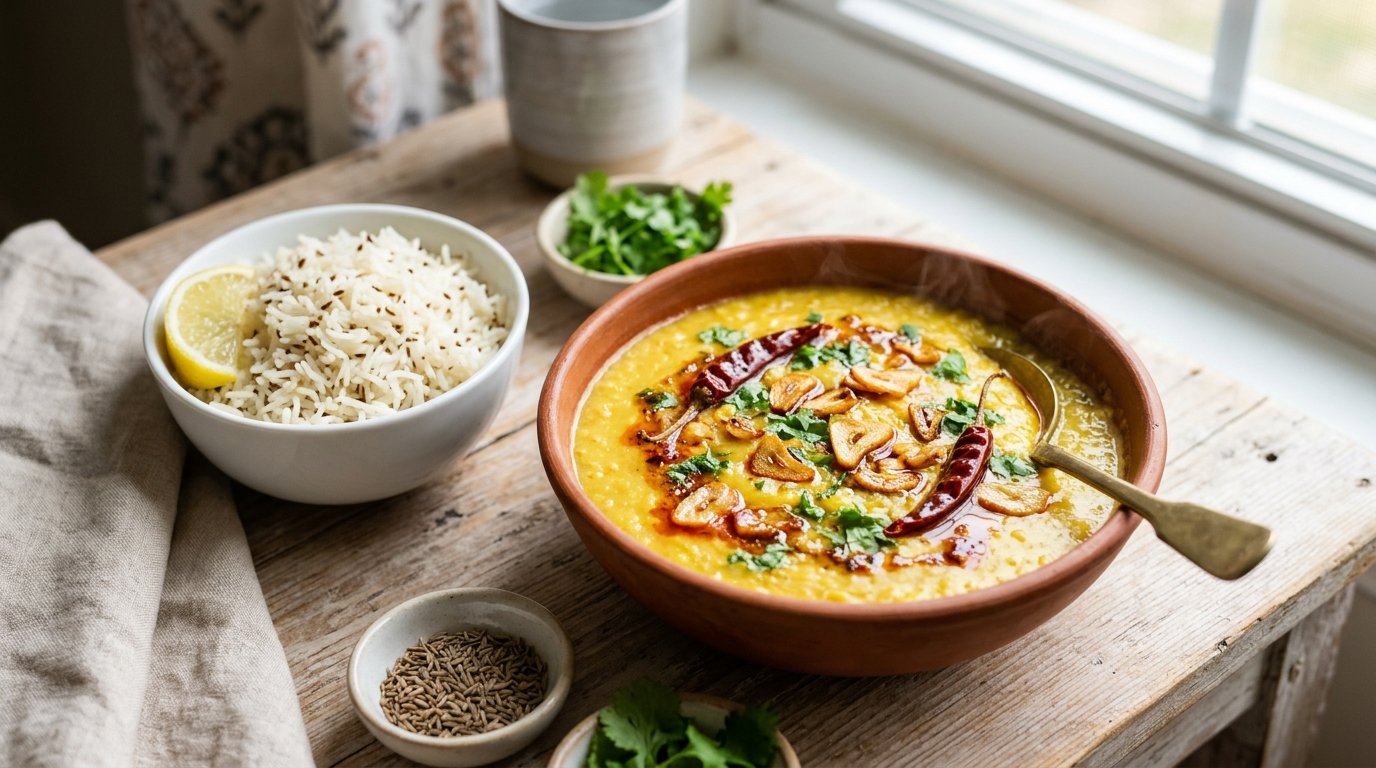
Dal tadka is a pot of soft, spoon-thick yellow lentils that gets its name from the last step: a hot tempering of ghee, cumin, garlic and dried red chillies poured over the top. It is sold as a North Indian dish and often labelled “Punjabi dhaba style”. Hebbar’s Kitchen describes it as a staple for everyday lunch and dinner, and I found no reliable source for a single origin story.
The taste is earthy and gently sweet from the lentils, with tomato and onion in the background and a sharp, toasty top note from the ghee and garlic. The texture should be creamy but still pourable, closer to a thick soup than a paste. It is a weeknight dish and a standard order beside rice or roti.
The name also separates it from its neighbour. According to Hebbar’s Kitchen on dal fry, dal fry begins with a spice tempering while dal tadka starts with cooked lentils. Swasthi’s Recipes uses the same idea: the tempering goes in at the end, with no further cooking. This version adds a short onion and tomato base first, in the restaurant style.
What you need
The lentils. Toor dal (split pigeon peas, also sold as arhar dal) is the usual base. Swasthi’s Recipes suggests a mix of toor, moong and a little chana dal, and Hebbar’s Kitchen uses toor with moong dal. Moong breaks down fully and makes the dal creamy; toor holds a little shape. Both are sold in Indian grocers and many large supermarkets.
The ghee. The finishing tempering is where the aroma comes from, so ghee is worth buying if you can. Cumin seeds go in first and should darken within seconds, then garlic until pale gold.
Hing and kasuri methi. Asafoetida (hing) is a pinch of resinous powder that smells sulphurous in the jar and savoury once it hits hot fat. Kasuri methi is dried fenugreek leaf; crush it between your palms to release its bittersweet smell. Both are optional if you can’t find them.
| Ingredient | Swap | What changes |
|---|---|---|
| Toor dal | Masoor dal (red lentils), same weight | Cooks faster and turns softer and more yellow-orange; skip the soak and expect 15 to 20 minutes on the stovetop |
| Moong dal | Extra toor dal, same weight | Slightly less creamy; whisk the cooked dal a little longer |
| Ghee | Neutral oil, same amount | Loses the nutty, buttery aroma; makes the dish dairy-free |
| Hing | Leave out; add 1 extra garlic clove to the tempering | Slightly less savoury depth |
| Kashmiri chilli powder | Sweet paprika, same amount, plus a tiny pinch of cayenne | Similar red colour, a little more heat |
| Dried red chillies | 1/4 tsp chilli flakes per chilli | Heat spreads through the dal instead of staying in whole pods |
Dal tadka
Soft toor and moong dal simmered with onion and tomato, then finished with a sizzling ghee tempering. This recipe has not been cooked by TheTasteHQ; it is written from published sources.
- Vegetarian
- Halal
Ingredients
Dal
- 150 g toor dal (split pigeon peas)
- 50 g moong dal (split yellow)
- 700 ml water
- ¼ tsp turmeric
Masala base
- 1 tbsp neutral oil
- ½ tsp cumin seeds
- 1 onion
- 2½ cm ginger
- 3 cloves garlic
- 1 green chilli
- 2 tomatoes
- ¼ tsp turmeric
- ½ tsp red chilli powder
- 1 tsp coriander powder
- 1 tsp salt
- 150 ml hot water
- ½ tsp garam masala
- 1 tsp kasuri methi (optional)
Tadka (tempering)
- 2 tbsp ghee
- 1 tsp cumin seeds
- 4 cloves garlic
- 2 dried red chillies
- 1 pinch asafoetida (hing), Many brands contain wheat flour. (optional)
- ½ tsp Kashmiri chilli powder
- 2 tbsp fresh coriander
- 1 tsp lemon juice (optional)
Equipment
Pressure cooker or heavy pot, Wide pan, Small tempering pan, Whisk
Method
- Rinse and soak. Rinse the toor and moong dal together in several changes of water, rubbing with your fingers, until the water runs mostly clear. Cover with fresh water and soak for 20 minutes, then drain.
- Cook the dal. Put the drained dal in a pressure cooker with the 700 ml water and the 1/4 tsp turmeric. Cook for 3 whistles over medium heat, then let the pressure release on its own. The dal should crush easily between your fingers. On the stovetop, simmer partly covered, skimming any foam, until completely soft, topping up with hot water if it dries out.
- Whisk the dal. Whisk or mash the cooked dal lightly until it looks thick and creamy with no water pooling on top. Set it aside.
- Start the base. Heat the oil in a wide pan over medium heat. Add 1/2 tsp cumin seeds and let them sizzle for 10 seconds, then add the onion. Cook for 6 to 8 minutes, stirring, until the edges turn golden.
- Add aromatics and tomato. Stir in the ginger, 3 garlic cloves and green chilli for 1 minute, until the raw smell goes. Add the tomatoes, the 1/4 tsp turmeric, chilli powder, coriander powder and 1 tsp salt. Cook for 5 to 6 minutes, pressing the tomatoes down, until they break into a soft paste and oil shows at the edges.
- Combine and simmer. Add the dal and the hot water. Bring to a boil (100°C), then reduce to a gentle simmer for 8 to 10 minutes, stirring often. Stir in the garam masala and crushed kasuri methi. The dal should be thick but pourable; add a little more hot water if needed.
- Make the tadka. Heat the ghee in a small pan over medium heat. Add 1 tsp cumin seeds for 10 seconds, then the sliced garlic. Cook for about 30 seconds until pale gold, then add the dried chillies and hing for a few seconds. Take the pan off the heat and stir in the Kashmiri chilli powder.
- Pour and finish. Pour the sizzling tadka over the dal straight away and stir half of it in, leaving some ghee glossing the top. Taste and add salt if needed, then finish with the coriander and the lemon juice, if using. Serve hot.
Contains: milk, gluten. Check the labels on packaged ingredients.
Written with AI assistance and reviewed by a human editor. This recipe has not been cooked in a home kitchen, so taste and adjust as you go. The header picture is an AI-generated illustration, a stock photo or an official press picture, not a photo of this exact recipe. Use halal-certified meat.
Tips for success
- Rinse until the water is mostly clear. Surface starch and dust make the cooking water foam and can leave a dull taste.
- Cook the dal until it collapses. Press a grain between your fingers: it should crush without resistance. Under-cooked dal stays grainy however long you simmer it afterwards.
- Whisk before you combine. A few turns with a whisk or the back of a ladle blends toor and moong into one creamy body. Water pooling on top means it needs more whisking.
- Brown the onion properly. Pale onion tastes raw in a dal this simple. Cook until the edges are golden, then add the tomatoes and keep going until oil shows at the sides.
- Keep the tempering moving. Garlic goes from gold to bitter in seconds, so lift the pan off the heat as soon as it colours. Add the chilli powder last, off the heat, or it scorches.
- Pour the tempering over just before serving. The sizzle and fragrance are most obvious straight away, and the ghee stays glossy on top. Adjust the thickness with hot water, not cold, so the dal keeps its heat.
Storing and reheating
The USDA Food Safety and Inspection Service (FSIS) says leftovers keep in the refrigerator for 3 to 4 days or in the freezer for 3 to 4 months (checked 2 November 2026). Cool the dal in shallow containers and refrigerate it within 2 hours.
Reheat in a saucepan, covered, until it reaches a rolling boil and 74°C measured with a food thermometer; FSIS gives that for leftovers and says to boil soups and sauces. Lentils thicken as they sit, so add a splash of hot water. Frozen dal can go straight into the pan without thawing, or thaw it in the refrigerator.
Serving ideas
Steamed basmati or jeera rice is the classic partner, and Hebbar’s Kitchen suggests jeera rice specifically. Roti, paratha or naan work as well. A simple cucumber and onion salad, a wedge of lemon and a spoonful of yoghurt or pickle round out the plate.
Diet and allergen notes
This dal contains no meat, fish or gelatin, so it is suitable for vegetarians. It is not vegan or dairy-free as written because of the ghee; use oil for both. It is not keto, since lentils are a pulse. No meat is involved, so the halal question only applies to the ghee and other packaged ingredients, which you should check for halal certification if that matters to you.
Allergens: milk (ghee). Many brands of hing are blended with wheat flour, so the dish is not labelled gluten-free here; look for a pure or gluten-free hing, or leave it out. Pulses can also bother people who are sensitive to legumes.
For variations, make it lasooni by adding more garlic to the tempering, or use whole masoor in place of the toor and moong, as Hebbar’s Kitchen does in its masoor dal tadka.
Questions
What is the difference between dal tadka and dal fry?
The order of work. Dal fry starts with a spice tempering and builds from there, while dal tadka starts with plain cooked lentils and ends with the tempering. Many restaurants blur the two.
Do I need to soak the dal?
Not strictly. Some recipes skip it and some soak for 15 to 20 minutes; soaking can shorten cooking a little. Rinse well either way.
Why is my dal watery or too thick?
If it is watery, simmer it uncovered for a few more minutes and whisk. If it is too thick, stir in hot water a spoonful at a time. Dal keeps thickening as it cools, so aim slightly looser than you want at the table.
Sources
- Swasthi’s Recipes: Dal Tadka Recipe (Restaurant Style)
- Hebbar’s Kitchen: Dal Tadka Recipe, Punjabi Dhaba Style
- Hebbar’s Kitchen: Dal Fry Recipe, Dhaba Style
- Swasthi’s Recipes: Toor Dal (Arhar Dal) Recipe
- USDA FSIS: Leftovers and Food Safety
Header image: illustration, AI-generated.